
Large-Diameter Water Rubber Hose Selection Guide: Precise Matching for Specific Pressure Conditions
In fields such as hydraulic engineering, agricultural irrigation, municipal water supply and drainage, and industrial fluid transport, large-diameter water rubber hoses play a vital role as crucial "blood vessels." However, faced with complex working conditions, selecting a hose that can both withstand pressure and offer lasting durability is often a key decision. Choosing the right hose not only ensures the safe and stable operation of your system but also effectively extends its service life, saving overall costs.
The core of selecting a large-diameter water hose lies in ensuring its rated pressure level perfectly matches the actual working conditions and incorporating a sufficient safety factor, thereby completely avoiding hose bursts, leaks, or even safety incidents caused by overpressure or improper matching.
Four-Step Precision Selection Method for Complex Pressure Conditions
Step 1: Accurately Calculate the Actual Working Pressure
First, it is essential to determine the system's actual maximum working pressure. This requires comprehensive consideration of factors such as pump outlet pressure, water transmission distance, vertical head, and pipeline losses. Special attention must be paid to including pressure fluctuation peaks, such as those caused by water hammer or during start-up and shutdown; otherwise, potential safety hazards can easily be overlooked.
Step 2: Enhance Safety with a Reasonable Safety Factor
Knowing the working pressure alone is not enough. A reliable safety factor is the "guardian" of the hose's long-term safety.
Standard Conditions (stable pressure, mild environment): A safety factor of 1.2 – 1.5 times is recommended.
Harsh Conditions (high pressure, frequent pulses, high ambient temperature, or corrosive media): The safety factor should be increased to 1.5 – 2.0 times.
Step 3: Scientifically Match the Hose Pressure Rating
Based on the value derived from the formula [Actual Max Pressure × Safety Factor], select a hose with a rated pressure equal to or slightly higher than this result.
Example: If the actual maximum pressure is 1.0 MPa and a safety factor of 1.5 is used, the required hose rated pressure should be ≥1.5 MPa. In this case, a standard 1.6 MPa grade product would be the preferred choice.
Step 4: Verify Reinforcement Layer Compatibility to Ensure Core Pressure Capacity
The rubber hose's "skeleton" – the reinforcement layer – directly determines its pressure resistance.
Low-Pressure Scenarios (≤0.8 MPa): High-strength synthetic fiber braid/spiral reinforced hoses can be used, offering economy and flexibility.
Medium-Pressure Scenarios (1.0 – 1.6 MPa): Options include fiber reinforced or fine steel wire braid reinforced hoses, balancing pressure capacity and flexibility.
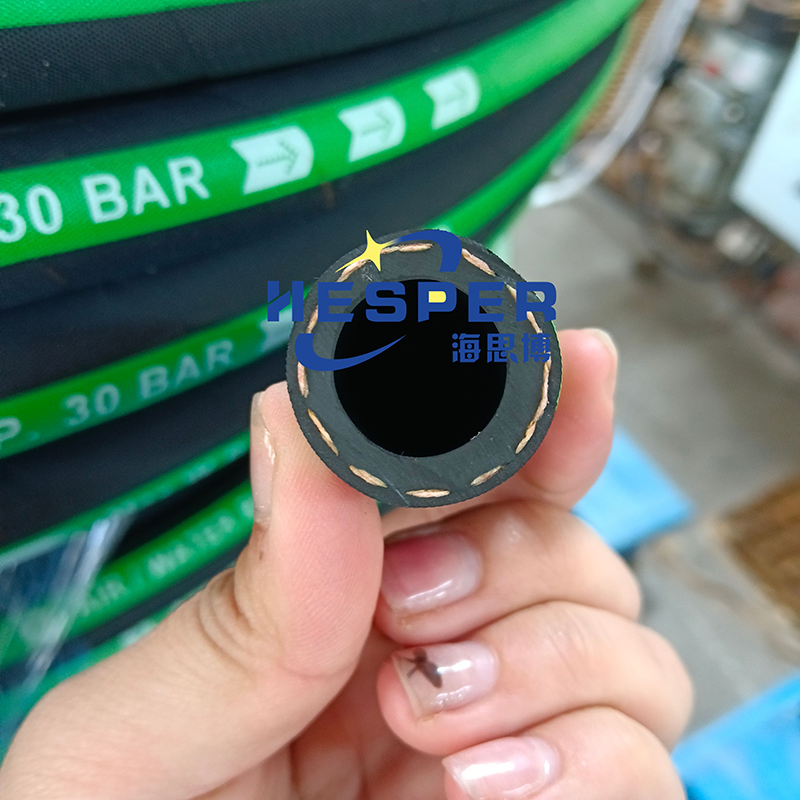
High-Pressure & Demanding Scenarios (≥2.0 MPa): Multi-layer steel wire spiral reinforced hoses are essential. Their excellent impact resistance and pulse fatigue performance provide a solid guarantee for high-pressure safety.
In-Depth Adaptation for Key Working Conditions for Enhanced Durability
Handling Frequent Pressure Fluctuations: Beyond selecting a slightly higher pressure rating, pay close attention to the hose's pulse fatigue cycle rating, opting for products validated through rigorous pulse testing.
Adapting to Extreme Temperature Environments:
High-Temperature Environments (>60°C): Hose pressure capacity decreases. Refer to the manufacturer's temperature-pressure correction charts for derating (e.g., a 1.6 MPa hose at 80°C might only be rated for 1.2 MPa).
Low-Temperature Environments (<-10°C): Select hoses made with specialized cold-resistant compounds. Their pressure rating remains unchanged, but they maintain excellent flexibility and pressure stability at low temperatures.
Mobile & Bending Applications: Higher-pressure hoses are typically more rigid. In scenarios requiring frequent movement or bending, a balance between pressure needs and flexibility must be struck to avoid reinforcement layer damage from excessive bending.
Choosing our large-diameter water rubber hoses means you can get more than just a product – you receive a complete pressure solution. We offer comprehensive services from technical consultation and pressure calculation to product selection, ensuring every length of hose operates safely, efficiently, and durably within your system. Contact our technical engineers to find the perfect water "artery" for your project!