Choosing the right Air Rubber Hose supplier can influence safety, uptime, and long-term operating costs. Global buyers often compare manufacturers across different regions, standards, and service capabilities. A supplier may offer attractive pricing, yet provide limited technical support or inconsistent delivery dates.
This guide examines seven established Air Rubber Hose suppliers for international purchasing teams. The comparison focuses on hose construction, pressure ratings, temperature resistance, customization, testing, and export experience. It also considers practical details, such as packaging, sample approval, response speed, and replacement support. These factors matter when hoses operate beside compressors, pneumatic tools, or dusty production lines.
No supplier is perfect. A polished website does not prove stable quality. A low quotation may hide weak reinforcement, unclear specifications, or expensive freight. That assumption can fail. Reliable evaluation requires checking product datasheets, factory credentials, inspection procedures, and customer references. Buyers should confirm working pressure rather than relying only on burst pressure. They should also review inner-tube materials, cover resistance, fitting compatibility, and storage guidance.
The selected companies represent different strengths, including broad product ranges, flexible customization, regional distribution, and manufacturing scale. Their suitability may vary by project size and destination market. An industrial distributor may need fast stock availability, while a mining operation may prioritize abrasion resistance and reinforced construction. This overview offers a practical starting point, not a substitute for technical verification. Careful questions before purchase can prevent costly hose failures later.
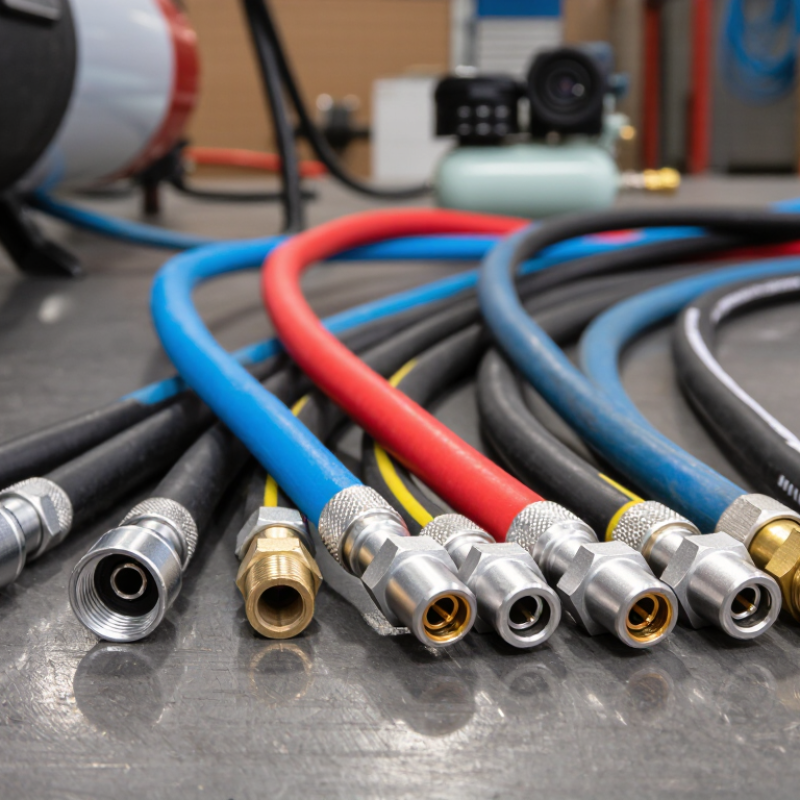
Air rubber hose carries compressed air through workshops, construction sites, factories, and mobile equipment. Its inner tube should resist air, oil mist, and temperature changes. Textile or wire reinforcement controls pressure expansion. The outer cover protects against abrasion, sunlight, ozone, and moisture.
Global buyers should define the working pressure, burst pressure, inner diameter, hose length, temperature range, and connection type. A 10 mm inner diameter hose can behave differently from a 13 mm hose under the same compressor load. Check pressure loss before ordering. Small fittings can restrict airflow.
Ask each of seven potential suppliers for technical data sheets, batch traceability, inspection records, and sample test results. Confirm whether testing follows recognized international or regional standards. Request documents in clear English when teams work across borders. Product markings should identify size, pressure rating, production date, and applicable temperature limits.
Packaging also matters. Hoses may sit in humid containers for weeks. Moisture-resistant wrapping and capped ends reduce contamination. Buyers should verify pallet dimensions, carton strength, customs documents, and replacement support. I have seen specifications look complete while omitting bend radius. That omission can cause field problems. No checklist is perfect. Test a sample in realistic conditions, including repeated bending, cold storage, and oil exposure, before approving a large shipment.
Choosing air rubber hose suppliers for global purchasing requires more than comparing quoted prices. Start by checking technical fit. Ask for working pressure, burst pressure, temperature range, inner diameter tolerance, and minimum bend radius. A reliable supplier should provide test reports for each production batch.
Request a sample before approving a large order. Measure the hose with calipers, then inspect its surface after repeated bending. Look for cracking, blisters, uneven reinforcement, or a strong chemical odor. Check whether the fittings seal correctly under operating pressure. Small defects often appear before larger failures. I have found that a clean cut end can hide weak reinforcement inside.
Supplier experience also matters. Review export history, production capacity, traceability procedures, and quality-control staff. Ask how they handle rejected batches and late shipments. Clear answers are valuable. Vague promises are not. Confirm packaging details, pallet protection, labeling, and storage conditions, especially for long ocean transport.
Evaluate documentation carefully. Material specifications, inspection records, and safety data should match the actual product. Independent testing can strengthen confidence when the application is demanding. However, paperwork alone is insufficient. A supplier may present excellent certificates but still deliver inconsistent batches. Speaking with recent customers can reveal communication delays, replacement policies, and real lead times. Allow room for mistakes in your own evaluation, too. One overlooked coupling dimension can disrupt an entire installation.
Global buyers now compare more than price. They examine pressure ratings, compound quality, traceability, and delivery discipline. Grand View Research reports that the global industrial hose market is expanding steadily, supported by construction, manufacturing, and energy demand. That growth increases supplier choice, but also increases confusion.
Supplier One focuses on reinforced workshop hoses with stable medium-pressure performance. Supplier Two offers flexible EPDM hoses for outdoor equipment. Supplier Three specializes in oil-resistant nitrile rubber designs. Supplier Four provides customized lengths and fittings for industrial assembly lines. Supplier Five competes through rapid export production and broad size availability. Supplier Six emphasizes temperature resistance for compressed-air systems. Supplier Seven serves demanding buyers with documented batch testing and custom packaging. These profiles sound similar. They are not.
Field experience shows that a hose can fail at the coupling, not the tube. Buyers should request burst-pressure data, working-pressure limits, bend-radius measurements, and test certificates. ISO 1307 provides recognized dimensions for rubber and plastics hoses. ISO 8330 also defines key hose terminology, helping buyers compare technical documents consistently. A 2024 MarketsandMarkets analysis identifies industrial hose performance and application specialization as important market drivers. Still, published figures may not reflect every factory’s real capacity.
Ask for recent inspection records. Check production photos. Confirm whether samples match mass shipments. Some suppliers report attractive pressure ratings without explaining temperature conditions. That deserves careful questioning. My own comparison would score reliability above the lowest quotation, although this approach can raise initial costs. Better evidence usually prevents expensive replacement work later.
When comparing seven air rubber hose suppliers, quality differences appear in the details. A reliable hose should show consistent inner diameter, wall thickness, working pressure, and burst pressure. Reinforcement layers must remain evenly positioned after bending. Check the rubber compound too. EPDM suits weather exposure, while NBR often handles oil contact better. Not every supplier provides clear test data.
Pricing can be misleading. A lower quotation may exclude fittings, testing, packaging, or export documentation. Compare the full delivered cost, including minimum order quantities, tooling fees, payment terms, and shipping time. Ask for samples before placing a large order. Inspect surface cracks, odor, flexibility, and coupling security. Look closer. A cheap hose that fails early creates replacement costs and production delays.
Global support separates capable suppliers from ordinary exporters. Strong suppliers respond with technical drawings, pressure charts, installation guidance, and traceable batch records. They should explain storage conditions and provide realistic lead times. Regional warehouses can reduce delivery delays, but inventory claims need verification. My own supplier comparison was not perfect; some samples performed well, yet communication weakened during revisions. That matters. Buyers should test hoses under actual temperature, pressure, and bending conditions before approval.
7 Best Air Rubber Hose Suppliers for Global Buyers?
How to Choose the Right Supplier for Your Application
Choosing an air rubber hose supplier starts with the working environment, not the catalog price. Check operating pressure, temperature, bending radius, abrasion, oil exposure, and coupling type. A hose rated for 20 bar may still fail under sharp bends or repeated movement. Ask for test reports, batch traceability, material specifications, and clear working-pressure limits. ISO 18752 provides useful performance classifications for rubber hoses. Suppliers that understand this standard can explain testing instead of making vague claims.
Installation details matter. Measure the actual hose length and inspect the connection points. A hose rubbing against a steel frame may need a protective sleeve or a different cover compound. The U.S. Department of Energy reports that compressed-air leaks can waste 20% to 30% of compressor output. Poor hose assemblies can contribute through damaged covers, loose couplings, or unsuitable fittings. Request leak-testing procedures and verify whether assemblies are tested before shipment. Small evidence matters.
Price still attracts buyers. I understand why. However, a cheaper hose can create downtime, emergency freight, and unsafe pressure loss. MarketsandMarkets identifies industrial automation and pneumatic equipment as continuing demand drivers in the global hose market. That growth does not guarantee quality. I would compare warranty terms, sample performance, replacement speed, and technical support across suppliers. Ask for one application-matched sample and test it on your equipment. One mistake remains easy to make: selecting a supplier by pressure rating alone.
Material temperature capability is one of the most important technical checks when comparing air hose suppliers. The ranges below are typical continuous-service values; actual limits depend on hose construction, pressure, fluid compatibility, and the manufacturer’s datasheet.
How to use this chart: Choose a supplier that can provide the required material, pressure rating, inner diameter, reinforcement, and compliance documentation for your application. EPDM is commonly selected for high-temperature or weather-resistant applications, while NBR is widely used for general industrial air service. Always verify the final operating range with the supplier.