Leave Your Message
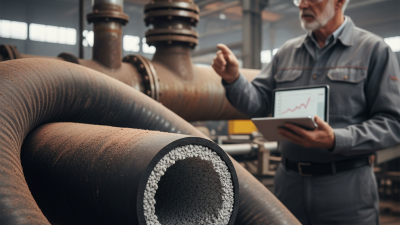
Choosing the right Ceramic Rubber Hose begins with the material being transported. A hose carrying sharp silica slurry faces different stresses from one moving cement powder or hot ash. Abrasion, pressure, temperature, bending radius, and chemical exposure must be considered together. One attractive specification rarely tells the whole story.
Dr. Werner W. Müller, a recognized rubber-technology author, states, “A lining must be selected for the complete service condition, not one test result.” This principle applies directly to Ceramic Rubber Hose selection. Ceramic tiles or embedded ceramic segments can resist severe wear, while the rubber body provides flexibility and vibration control. However, ceramic hardness alone does not guarantee long service. Joint design, bonding quality, hose movement, and installation support matter just as much.
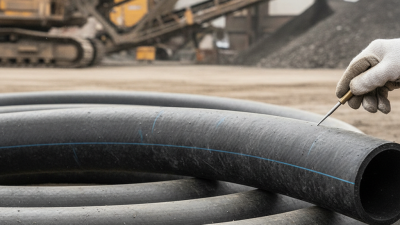
Look closely at the operating details. A hose dragging across a steel platform may need a reinforced cover. A vertical discharge line may require stronger end connections. Slurry density can change pressure loss and accelerate wear. Small bends near the flange can create hidden stress. Those details are easy to miss. That is the uncomfortable part.
A reliable choice should combine manufacturer data, application history, inspection records, and qualified engineering advice. Ask for abrasion testing, pressure ratings, temperature limits, and bend-radius information. Confirm whether the stated performance matches your actual media. In practice, the cheapest hose may become the most expensive component after repeated shutdowns. Even experienced teams can misjudge service conditions. Careful selection remains a process of checking, questioning, and sometimes revising assumptions.
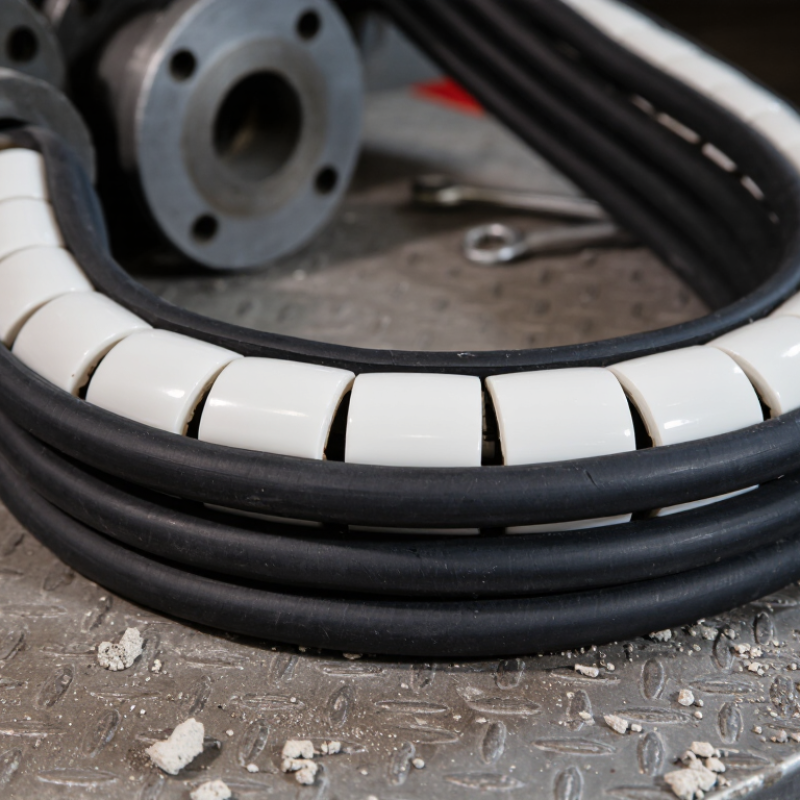
Choosing a ceramic rubber hose starts with operating conditions, not the hose catalogue. Record the conveyed material, temperature, pressure, flow rate, and installation layout. Note whether the line runs continuously or in short, intense cycles. A hose that performs well at room temperature may soften or crack near its limit. Small details matter. Measure them.
Material behavior determines the ceramic lining and rubber construction you need. Sharp sand, crushed stone, ash, and mineral slurry can cause different wear patterns. Particle size, hardness, shape, concentration, and velocity all affect service life. A dense slurry may create heavy abrasion at bends. Dry powder can generate dust, heat, and static concerns. Check chemical compatibility too, especially when water contains salts, cleaning agents, or process additives. Do not assume “non-corrosive” means harmless to every rubber compound.
On site, inspect the tightest bend and the nearest connection. These locations often reveal poor hose selection first. Confirm minimum bend radius, vacuum resistance, coupling movement, and support spacing with the supplier’s technical data. In my experience, operators sometimes specify pressure correctly but overlook surge pressure during pump start-up. That oversight can be expensive. I also prefer leaving a modest safety margin, although too much margin can make the hose unnecessarily stiff. Review actual wear after installation, then adjust the specification instead of defending the original choice.
Use the operating-condition data below to identify the required ceramic lining, rubber compound, reinforcement, and hose configuration.
| Operating or Material Factor | Typical Design Input | Recommended Ceramic Rubber Hose Specification | Reason for Selection | Selection Priority |
|---|---|---|---|---|
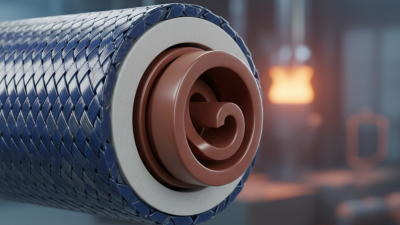
| Conveyed material | Dry or wet abrasive solids such as mineral concentrate, silica sand, limestone, cement, ash, slag, or slurry | Use a ceramic-lined hose with abrasion-resistant rubber and embedded ceramic tiles or ceramic segments in the wear zone. | Ceramic provides high resistance to sliding and impact abrasion, while rubber absorbs vibration and protects the lining from mechanical shock. | Critical |
| Particle size and shape | Fine powder, rounded particles, sharp particles, or coarse particles generally below approximately 25–50 mm | Fine particles may require a smooth ceramic lining. Sharp or coarse particles require thicker ceramic sections, impact-resistant geometry, and suitable hose reinforcement. | Large, angular particles can create concentrated impact loads and may damage thin linings or poorly supported ceramic sections. | Critical |
| Material hardness | Soft solids below approximately 3 Mohs; hard minerals and silica-rich solids around 6–7 Mohs | For hard minerals, select dense alumina or another wear-resistant ceramic grade with an abrasion-resistant rubber backing. | Harder conveyed particles normally increase wear rate, especially at elbows, reducers, hose ends, and changes in flow direction. | Critical |
| Solids concentration | Low-solids liquid, dilute slurry, or high-solids slurry by weight or volume | Higher solids concentration generally requires a thicker ceramic wear layer, stronger reinforcement, and a rubber compound compatible with the carrier liquid. | More solids increase the number of particle impacts and sliding contacts per unit of conveyed liquid. | Critical |
| Flow velocity | Low, moderate, or high velocity; specify the actual velocity in m/s | For abrasive slurry, avoid unnecessary velocity. Where high velocity is unavoidable, use a wear-focused ceramic lining and inspect the highest-flow zones first. | Abrasive wear generally increases as particle speed and impact energy increase. The exact effect depends on particle size, angle, concentration, and fluid properties. | Critical |
| Operating temperature | Ambient service, elevated temperature, or temperature cycling; specify normal and maximum temperature in °C | Select a rubber compound rated for the continuous and peak temperature. For many general-purpose rubber-lined applications, continuous service is commonly limited to approximately 80–90°C, but the actual rating depends on the compound and construction. | Excessive temperature can soften rubber, reduce adhesion, accelerate aging, and cause thermal expansion differences between rubber and ceramic. | Critical |
| Pressure | Normal working pressure, pulsation, surge pressure, and test pressure in bar or MPa | Choose a hose with a working-pressure rating above the maximum steady pressure and evaluate reinforcement for pulsation and pressure surges. | Pressure capacity is governed mainly by reinforcement, end connections, temperature, and dynamic loading; ceramic lining alone does not determine pressure rating. | Critical |
| Vacuum or suction service | No vacuum, partial vacuum, or full vacuum under suction conditions | Specify a vacuum-rated hose with suitable helix or embedded reinforcement. Confirm the vacuum rating at the operating temperature and bend condition. | External pressure can collapse a hose even when its internal pressure rating is adequate. | Critical |
| Operating environment | Indoor, outdoor, high humidity, salt exposure, oil mist, sunlight, ozone, or chemical atmosphere | Use an outer cover resistant to weathering, ozone, oil, moisture, or chemicals as required. Protect exposed hose from direct sunlight and standing water when applicable. | The cover protects reinforcement and prevents premature aging, swelling, cracking, or corrosion-related damage. | Important |
| Liquid chemistry and pH | Water-based slurry, acidic slurry, alkaline slurry, solvent-containing liquid, or unknown chemistry | Match the rubber compound and any bonding layer to the liquid. Obtain chemical compatibility data for the exact concentration, temperature, and exposure time. | Ceramic may resist many chemicals, but the rubber matrix, adhesive, and cover can be the limiting components. | Critical |
| Required bend radius | Minimum installation radius, repeated flexing, or static positioning | Select a flexible construction with a specified minimum bend radius. Do not bend below the manufacturer’s limit, especially near ceramic-lined sections and couplings. | Over-bending can damage reinforcement, separate ceramic segments, flatten the bore, or reduce flow area. | Critical |
| Flexing and movement | Static line, occasional repositioning, continuous movement, or severe vibration | Use a flexible rubber construction for movement and provide adequate unsupported length. For continuous motion, confirm fatigue and flex-cycle suitability. | Repeated flexing creates mechanical stress in the rubber, reinforcement, bonding layer, and ceramic segment interfaces. | Important |
| Impact exposure | Low-impact fines, intermittent coarse solids, or frequent large-particle impact | For high-impact service, use impact-resistant ceramic arrangement, sufficient rubber support behind the ceramic, and a hose geometry that minimizes direct impact at the bend. | Ceramic is highly wear-resistant but can be brittle if subjected to unsupported point impact or excessive installation stress. | Critical |
| Hose diameter | Internal diameter selected from required flow rate, allowable velocity, and available pressure drop | Size the bore to maintain the target velocity without excessive turbulence or pressure loss. Consider a larger diameter where solids settling is possible at low velocity. | An undersized hose increases velocity and wear; an oversized hose may reduce conveying velocity and allow solids to settle. | Critical |
| Electrical conductivity | Nonconductive powder, conductive slurry, static-sensitive material, or hazardous area | Specify an electrically conductive or antistatic construction when static-charge dissipation is required, and ensure continuity through couplings and grounding points. | Rubber hoses can accumulate static charge. The correct electrical specification depends on the process and applicable safety requirements. | Important |
| Connection method | Flanges, clamps, threaded ends, cam-and-groove couplings, or custom connections | Use correctly sized couplings with smooth transitions and avoid protruding gaskets, bolt ends, or misaligned joints inside the flow path. | Internal obstructions create turbulence and localized wear, while misalignment can impose damaging loads on the ceramic lining. | Critical |
| Installation alignment | Straight run, elbow, offset, vertical drop, or unsupported span | Use a purpose-designed bend or elbow section where flow direction changes. Support the hose without restricting its natural movement or crushing the cover. | Elbows and unsupported offsets often experience the highest wear, stress, and vibration in an abrasive conveying system. | Critical |
| Inspection and maintenance | Continuous operation, periodic shutdown, or condition-based maintenance program | Provide inspection access and establish checks for cover cracking, bulging, leakage, exposed reinforcement, coupling movement, and changes in pressure drop. | Early detection helps prevent sudden failure and identifies whether wear is concentrated at bends, ends, or straight sections. | Important |
| Safety factor | Required margin above working pressure and temperature, considering dynamic conditions | Use the applicable hose standard, project specification, and supplier test data. Do not select solely from nominal pressure or diameter. | Actual service may include surges, temperature derating, flexing, pulsation, and chemical aging that reduce the effective service margin. | Critical |
Engineering note: The values and ranges shown are general selection guidance rather than a substitute for a product-specific design review. Final hose selection should be based on the exact material composition, particle size distribution, concentration, temperature, pressure, vacuum, flow velocity, bend radius, chemical exposure, connection design, and applicable safety standards.